

The Power Surge: Factors Driving the Rising Demand for Electricity
Font Size:
Across the U.S., the demand for power is climbing at one of the fastest rates in decades. As the economy becomes more reliant on electricity and data centers continue to sprout up in many parts of the country, rural electric utilities like OPD5 are preparing to meet the challenges that skyrocketing demand brings.
The North American Reliability Corporation––the watchdog for the U.S. electric grid––recently released its latest Long-Term Reliability Assessment. This report found that the reliability outlook for the U.S. grid is “worsening” amid projections for more power plant retirements and surging demand from data centers and other large loads in the next decade.
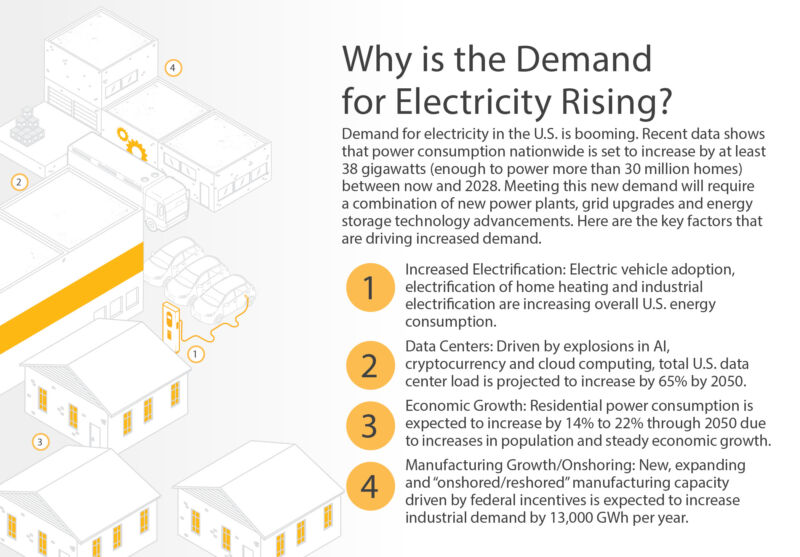
Several key factors are driving that increased demand—including economic growth, expanded manufacturing, data center development and increased electrification in transportation. Together, these trends are reshaping how much electricity we consume and how quickly utilities like OPD5 must adapt to meet future needs.
One of the biggest drivers of rising demand is increased electrification. More homes and businesses are transitioning to electricity for home heating, water heating and transportation. EVs are becoming more common on the road. Smart appliances, connected devices, home offices and entertainment systems are adding to overall consumption, even as efficiency improves.
Data centers are another major contributor to rising demand. These facilities require huge amounts of power to operate servers and cooling systems 24/7. Tech companies are building new facilities nationwide––many of which are in rural areas served by small utilities.
Economic and manufacturing growth are also contributing to higher electricity use. As businesses expand and new industries take root, especially in rural and suburban areas, the demand for reliable, high-capacity power is increasing. These facilities often require substantial energy loads, and many operate continuously to keep production lines running. This growth brings jobs and investment, but it also puts new pressures on the electric grid.
While increased demand presents new challenges, it also has the potential to create significant opportunities. Small electric utilities like OPD5 are responding by planning carefully for the future.
Over the past year, OPD5 has been in the midst of a veritable capital infrastructure boom, with multiple major projects in the works.
Perhaps top on the list of these is the new 138 kilovolt transmission line that has been taking shape across the Mormon Mesa along I-15. This second line will deliver power from the district’s main hub at Tortoise Substation in Moapa to the Gila Substation at Riverside, bringing full redundancy to the Virgin Valley communities as well as new back feed capability to supply the Moapa Valley if needed.
Another set of vital projects includes construction of the new Long Drive Switchyard near the Mesquite Sports Complex, and a new Raptor Substation on the western end of Mesquite. The switchyard will provide multiple feeders off of a major transmission line entering the valley in that area, distributing power load evenly to three substations that supply power to a large swath of the community. The new Raptor Substation has been built to adequately service the current and future load of the Commercial and Industrial park area in western Mesquite.
A series of ongoing upgrades at multiple OPD5 substations both in Mesquite and in Moapa, will provide additional switching flexibility and increase overall capacity and efficiency across the system. These updates are expected to be completed this year as well.
Electricity powers nearly every aspect of today’s economy, and its role will only grow stronger. As electrification accelerates, long-term planning becomes more important than ever.
OPD5 is ready to meet rising demand in our local communities. Through innovation, investment and collaboration, we are preparing for a more reliable and resilient energy future.